What is AI Fluency?
A research-based definition of the AI skills every employee needs
Leaders want their people to build AI skills. Ask what those skills are, and the answers split; one leader means writing better prompts, another means never pasting client data into a chatbot.
Without a shared definition, training lands unevenly and managers have no way to tell who is using AI well.
The research uses different labels (AI fluency, AI literacy, AI acumen), but it converges on the same four steps. Some of what it describes is restraint. Glean’s 2026 Work AI Index found that high AI performers are 18% more likely to deliberately hold back from using AI.
At JST People Strategy, we believe AI fluency and AI competency are different things, and organizations need to define and build fluency first. Fluency is the floor everyone needs. Competency is the judgment people apply once AI is part of their role.
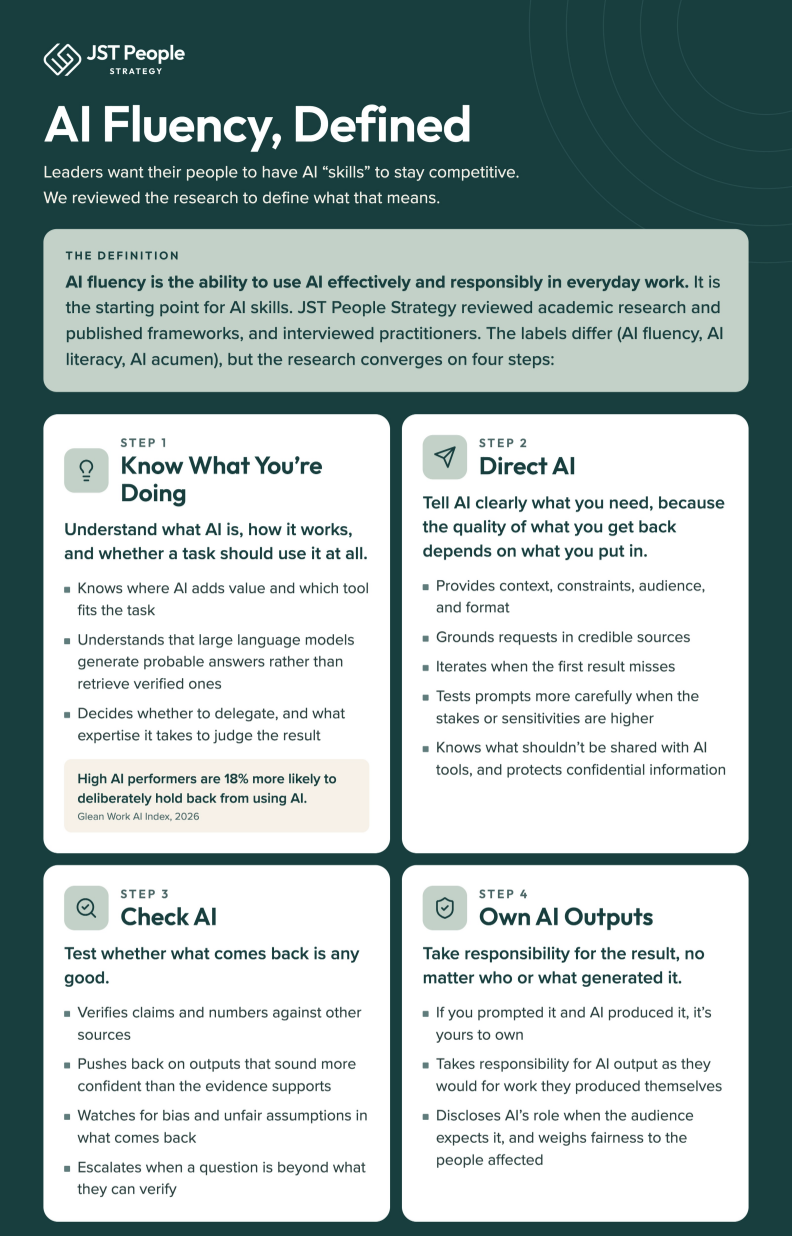
That’s why we created AI Fluency, Defined, a one-page reference that synthesizes academic research, published frameworks, and practitioner interviews into four steps:
Know what you’re doing: understand how AI works and whether a task should use it at all
Direct AI: give clear context, constraints, and sources, and protect confidential information
Check AI: verify claims, push back on overconfident answers, and watch for bias
Own AI outputs: take responsibility for the result and disclose AI’s role when the audience expects it
Each step lists the observable behaviors that show it, so you can use it to set expectations and design training.